400 participants join lively celebration of Cita Riga’s project Co-Creating Urban Heritage with Children Through Play, Latvia
On 30 August 2026, the historic watermill of Mazjumprava Manor on the outskirts of Rīga provided the setting for a lively, intergenerational celebration of Cita Rīga’s project Co-Creating Urban Heritage with Children Through Play, recipient of a European Heritage Award / Europa Nostra Award 2026 in the category Education Training and Skills.

Initiated by the NGO Cita Rīga, this grassroots initiative invites children aged 7 to 17 to discover and explore Rīga’s urban heritage through play, investigation and creative activities. With a low-cost and easily replicable approach, the programme transforms neighbourhoods into open-air learning spaces, encouraging younger generations to engage with their surroundings and build lasting connections with local heritage.

Designed as an open and participatory heritage event, the celebration brought the project’s approach to life: learning about history not simply by listening, but by exploring, experimenting and doing. Visitors of all ages could discover the history of Rīga and Mazjumprava through games, storytelling, creative workshops and practical experiments, turning the historic site into a shared space for learning and discovery.
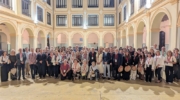
Around 400 people attended the event, including members of the public and representatives of the Latvian Government and Rīga Municipality. Among the guests were Vineta Skujiņa, Adviser to the Minister of Education and Science on State Language and Educational Content; Baiba Mūrniece, Deputy State Secretary for Cultural Policy at the Ministry of Culture; and Laima Geikina, Chair of the Rīga City Council Committee for Education, Culture, Sports and Youth.

Andris Kužnieks, Head of the European Commission Representation in Latvia, and Graham Bell, Board Member of Europa Nostra, took part in the event.
Andris Kužnieks praised the project for highlighting the European dimension of Latvia’s cultural heritage. “Mazjumprava and its history symbolise the fact that Latvia has always belonged and will continue to belong to Europe. By exploring history through different interactive methods, this place connects us with Europe and reminds us that we have always been part of it,” he underlined.

Graham Bell conveyed Europa Nostra’s message about the importance of involving people in the ongoing story of heritage, emphasising that “you and those who come after you are living the story. The Awards are run by Europa Nostra with support from the Creative Europe Programme of the European Union; this initiative is a model of a creative Europe – an inspiration for other communities across the continent,” he underlined.

Graham Bell congratulated the project team and explained why the initiative had so impressed the Awards’ jury. The recognition celebrates the project’s imaginative approach to heritage education and its success in giving children an active role in discovering, interpreting and caring for the places around them.
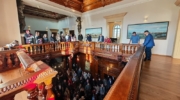
The visit to Rīga also offered Graham Bell an opportunity to meet representatives of cultural heritage organisations in Latvia. The discussion took place at the impressive premises of the Riga Latvian Society, a Europa Nostra Member Organisation, and was hosted by its Chairman, Guntis Gailītis.