A post-war gem worth fighting for: Kortrijk Railway Station, Belgium
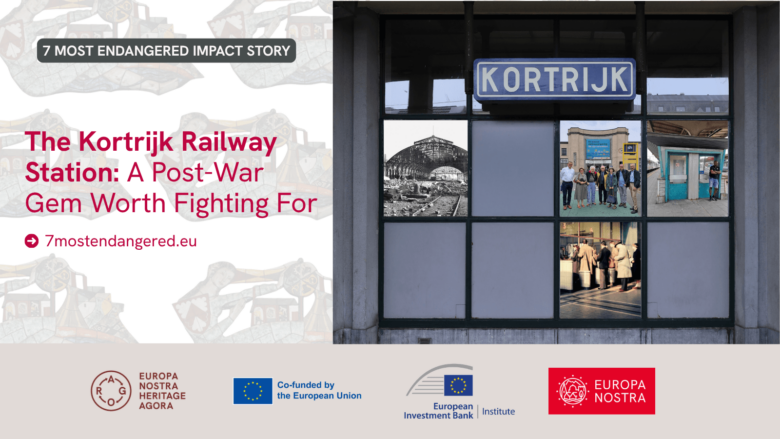
Rebuilt in 1951 to a design by architect Pierre Albert Pauwels, Kortrijk Railway Station in Western Belgium is a landmark of post-war architecture in the Expo 58 style, blending neoclassical and contemporary elements. Since 2015, when the station’s owner unveiled their plans for a new station, the building has been under threat of demolition, which would mean the loss not only of an architectural gem but also of a much-used public space. Kortrijk Railway Station was listed among the 7 Most Endangered heritage sites in Europe for 2023 by Europa Nostra.

Since its involvement in the 7 Most Endangered Programme, the station has gained international attention and a stronger voice in the debate over its future. The Flemish Association for Industrial Archaeology (VVIA), which nominated the site to the programme with the endorsement of Europa Nostra Belgium, has campaigned against demolition and for the building’s sustainable reuse, with the ambition of showing that post-war railway heritage can be conserved and given new life as a public space.
Europa Nostra spoke with Hendrik Nelde, President of VVIA, who has led the campaign to save the station, to hear about its inspiring journey.
What was the situation of the site when it was selected for the 7 Most Endangered Programme, and what was at stake?
The station was in danger, and from 2008-2009, the city started discussions with the owner of the Kortrijk station and the national transport company, the SNCB, about better transport connections for the city. They thought, but never communicated publicly that demolition was under consideration, so we had nothing to protest against. In 2016, it was announced for the first time that the station might go, to create a good connection for city trains and buses. We still had no concrete facts to react to at the time.

It was important for us to preserve this unique site. It is the only large building of post-war architecture in which the local government wanted to show that it had won the war against the Germans and could build something big. It dates from around 1958, the year of the World Expo, and speaks directly to that period.
About four years ago, the City of Kortrijk, the SNCB and De Lijn announced the demolition at a moment of low media attention. That is when we really started to protest. The authorities organised a press conference, and I went in and asked questions. I asked whether the public had been informed in time of such a huge project, when a follow-through project already existed. That was hard for the mayor to answer. That was where it all started.
Until then, everything had been black and white. Then the mayor invited us to a meeting with himself and the alderman partly responsible, Mr. Maadens. We went in as a united front and made an agreement that both sides would inform each other before reaching out to anyone else. That was a very important point.
We fought by using the law. The permission to demolish and build a new station comes from the Flemish Government, not from the City of Kortrijk, so we contested the permission to build a new station through the High Council for Permit Disputes (De Raad voor Vergunningsbetwistingen), which ruled in our favour. By then, the Kortrijk Railway Station had already been selected as one of the 7 Most Endangered heritage sites in Europe.
What difference did the 7 Most Endangered Programme make, and was there a particular moment that marked a turning point?
The 7 Most Endangered Programme gave us international attention. We could tell our local government that we had international standing behind our vision for the building. The city wanted to be a European Capital of Culture for the year 2030, and we told the mayor: you will never achieve that at any level if you demolish this building. We used this argument intensively to show that the concern was not confined to their political region but was European.

The turning point was being able to talk to the press about it. This is an argument the press cares about, and suddenly there was massive outreach. Knowing that we have the support of a European initiative gave us the legitimacy to speak for many people, not only locals. When people are aware that there is international involvement, it makes local stakeholders and politicians think this matters.
Who are the people behind this project, and what role have they played in protecting the site?
The biggest medal goes to Adriaan Linters, past president of the Flemish Association for Industrial Archaeology (VVIA) for six years, who passed away on 30 May 2025. I took over as president three years before his death. He was the first to say this building was worth fighting for, and I agreed. I tried to follow in his footsteps by motivating the VVIA to see how important the Kortrijk Railway Station is.
We also had a task force called “Save the Station”: myself and four others, meeting every four to six weeks depending on what was on the agenda. Locals from the surrounding area were also involved in this task force.
What does the future look like for the site today, and what gives you hope?
We are positive about the results already achieved, but what gives me less hope is that the future of the station depends now on the railway company. Even if the city or the people want something to happen, it is not their decision. It belongs to the owner. I hope they don’t wait too long to find new use for the building. A building only has a chance if it is connected to the place around it. An empty building means nothing. It needs income, tenants, warmth, open windows.

What gives me hope is the pressure of the people, our organisation – the Flemish Association for Industrial Archaeology (VVIA) – and the 7 Most Endangered Programme. Together, we have shown how important the Kortrijk Railway Station is.
The Europa Nostra team would like to extend our sincerest gratitude to Hendrik Nelde for his participation in this interview, which was edited for length and clarity.
About Impact Stories series
Since 2013, the 7 Most Endangered Programme – run by Europa Nostra with the support of the European Investment Bank Institute and the Creative Europe Programme of the European Union – has been committed to the protection of European heritage at risk. In this time, 77 threatened monuments and heritage sites from across 35 countries have been selected, each with its own unique history, community and story to tell. From ancient ruins to industrial landmarks, the sites reflect Europe’s diverse cultural landscape and the equally diverse challenges they face.
As part of our ongoing mission, we want to create a space dedicated to celebrating the people and organisations behind these sites, showing the long-term impacts of each small step taken in or beyond this Programme.
The 7 Most Endangered Impact Stories series is built around stories from selected sites across the Programme, drawing on interviews with the nominators and people directly involved in the Programme.
The first stories are being published in conjunction with the 2026 theme of European Heritage Days “Heritage at Risk: Revive, Resist, Reimagine” to join efforts in showcasing the many possible pathways towards safeguarding and giving new life to our heritage.