Building resilience for cultural heritage in the face of climate change: Europa Nostra contributes to SD-WISHEES conference in Tbilisi, Georgia
How can research, international cooperation and civil society advocacy help safeguard cultural heritage from climate change? And how can evidence translate into meaningful changes in policy, funding and practice? These questions were at the heart of the international conference Resilient Cultural Heritage: Building Bridges between Research, Policy and Practice, held in Tbilisi, Georgia, from 10 to 12 November 2026, within the framework of the EU-funded SD-WISHEES project.[1]
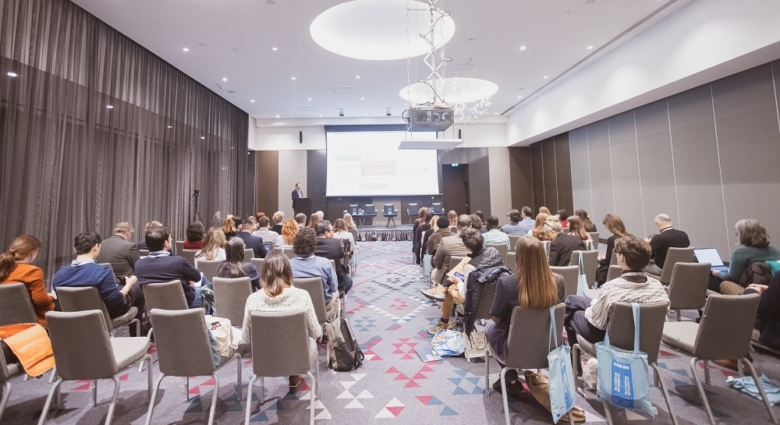
Photo: Courtesy of SD-WISHEES
The conference brought together researchers, policymakers, heritage professionals, civil society representatives and international organisations to explore ways of strengthening cultural heritage resilience in the face of hydroclimatic extreme events, including floods and droughts. Discussions addressed the links between water management, climate adaptation and the protection of tangible and intangible heritage.
Vanessa Fraga Prol, Advocacy and Partnerships Manager at Europa Nostra, represented both Europa Nostra and the European Heritage Hub, highlighting the role of civil society, international cooperation and heritage advocacy in climate adaptation and disaster-risk reduction.
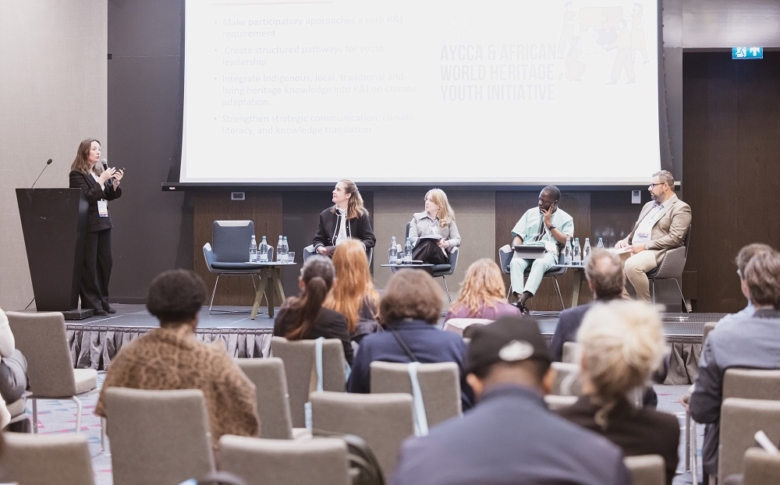
Photo: Courtesy of SD-WISHEES
Her intervention recognised progress in acknowledging cultural heritage both as vulnerable to climate change and as a contributor to solutions. However, heritage must be understood not as a separate policy sector, but as a vector across wider policy priorities. Through its advocacy and leadership of the European Heritage Hub, Europa Nostra has consistently called for heritage protection to be integrated into environmental planning, climate adaptation and disaster-risk reduction from the outset.
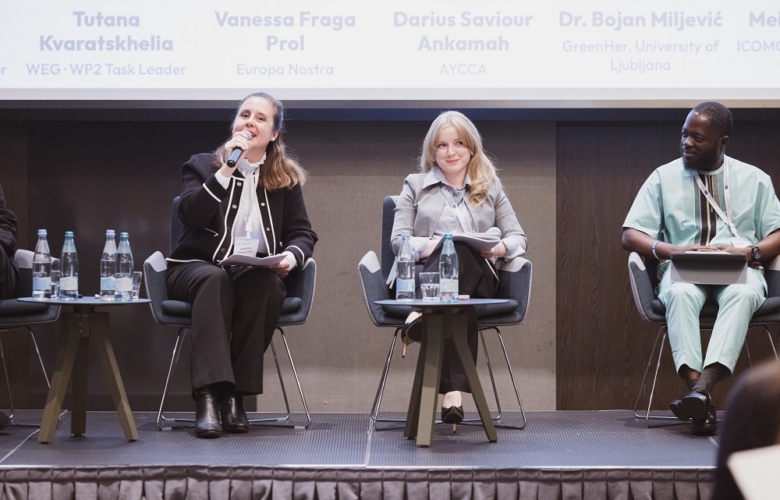
Photo: Courtesy of SD-WISHEES
Four contributions of civil society were highlighted:
– Building coalitions beyond the heritage sector, connecting climate scientists, environmental researchers, civil protection authorities, urban planners, local authorities and communities.
– Advocating for heritage in wider policy frameworks, including National Adaptation Plans, the EU Civil Protection Mechanism and disaster-risk reduction strategies.
– Using heritage places as laboratories for climate adaptation. The European Heritage Hub’s Intergenerational Climate Conversations have explored links between cultural and natural heritage, biodiversity, water governance and youth participation through examples from Sagres (Portugal) and Ostia Antica (Italy).
– Connecting research and innovation, bringing together initiatives, researchers and innovators to identify shared priorities, exchange knowledge and scale up solutions.
Despite progress, important gaps remain in data, monitoring, comparable indicators, vulnerability assessments and risk mapping. Intangible heritage and traditional knowledge also remain insufficiently represented. Moreover, political recognition has yet to translate into adequate financial commitments. The European Partnership for Resilient Cultural Heritage is an important step, but sustained funding is also needed for implementation, maintenance and capacity-building, alongside research.
At international level, recognition of culture in climate discussions has grown, from the establishment of the Group of Friends of Culture-Based Climate Action following COP28 to the inclusion of culture in the official COP30 Action Agenda in Belém. During COP31 in Antalya, the Climate Heritage Network and its partners continue to advocate for a stronger place for cultural heritage in climate action.
A central theme of the intervention was the European Heritage Hub’s role in connecting knowledge exchange with policy influence. The Hub provides a European platform for networking, knowledge and advocacy.
Connecting research, policy and practice
The wider conference explored how research and cooperation can support more effective climate resilience.
Discussions underlined that, although climate processes are global, their impacts on heritage are experienced locally and shaped by geographical, social, economic and governance contexts. Addressing them requires a better understanding of interconnected risks and closer cooperation between heritage, water, environmental and research communities. Examples ranged from the devastating Florence floods of 1966 to current challenges in water governance and heritage protection.
Civil society organisations were recognised not simply as project implementers, but as contributors to knowledge, community mobilisation and locally grounded solutions. Their work requires stronger political recognition and long-term support.
The importance of inclusive governance was also emphasised. Amanda Loeffen, CEO of Human Rights 2 Water, presented a human rights-based approach to research and innovation, highlighting participation, non-discrimination, transparency, access to data, accountability and sustainability.
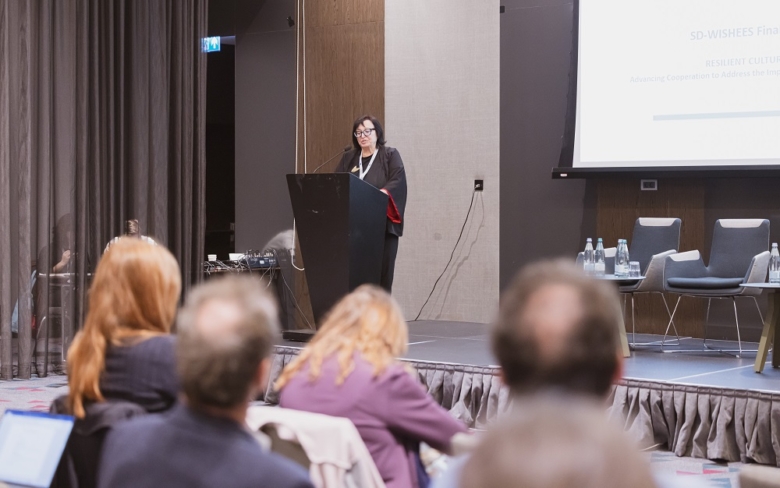
Photo: Courtesy of SD-WISHEES
Maka Dvalishvili, Head of the Georgian Arts and Culture Centre, Europa Nostra country representation in Georgia, drew attention to the need to better integrate cultural heritage into national climate adaptation and environmental governance frameworks. Legislative and institutional gaps remain, particularly in recognising heritage explicitly within climate adaptation policies.
The discussions further stressed the value of connecting existing research initiatives, data infrastructures and communities of practice. The SD-WISHEES Thematic Annual Programming (TAP) offers a mechanism to align national and regional research and innovation activities around shared priorities, bringing funding organisations, researchers and institutions closer together.
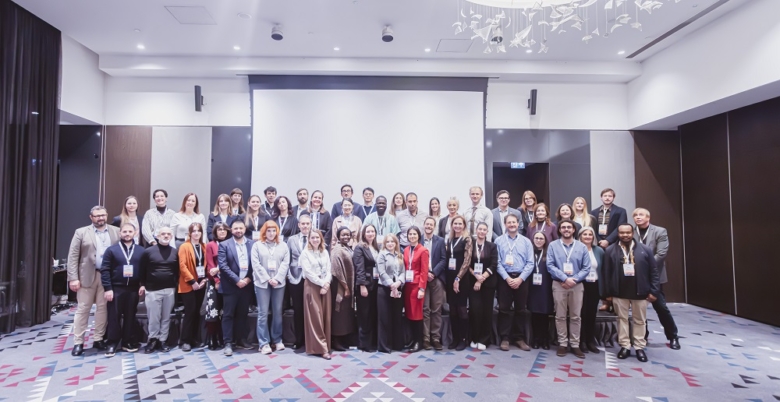
Photo: Courtesy of SD-WISHEES
Strengthening the role of heritage in climate resilience
For Europa Nostra and the European Heritage Hub, the discussions in Tbilisi reinforced the importance of positioning cultural heritage as an integral part of climate adaptation.
Heritage is not only exposed to climate-related risks; it can also strengthen resilience through traditional knowledge, locally adapted practices, sustainable resource management and nature-based solutions. Realising this potential requires closer cooperation between heritage professionals, scientists, policymakers, civil society organisations and local communities.
The conference provided an opportunity to exchange experiences, strengthen international connections and identify avenues for collaboration. It reinforced the need to move beyond fragmented initiatives towards more coordinated, inclusive and forward-looking approaches.
Safeguarding heritage in a changing climate requires better research and policies, but also sustained cooperation, shared responsibility and the active involvement of the communities who care for and transmit it.
More information
[1] SD-WISHEES – Supporting and Developing Widening Strategies to tackle Hydroclimatic Extreme Events: Impacts and Sustainable Solutions for Cultural Heritage – is a Horizon Europe-funded Coordination and Support Action coordinated by the Italian National Research Council. It strengthens cooperation between European and widening countries and international partners, including those in the Western Balkans, Caucasus and Africa.