A gradual path to recovery: How the Polirone Monastic Complex of San Benedetto Po in Italy became a model for community-led conservation
When an earthquake struck the Northern Italian regions of Emilia-Romagna and Lombardy in 2012, the Polirone Monastic Complex of San Benedetto Po suffered extensive damage. The loss was twofold: an impressive 16th-century Renaissance architectural structure was devastated, and its surrounding community lost access to one of their most important cultural spaces.

Since being listed among the 7 Most Endangered heritage sites in Europe for 2013, the restoration and recovery of the monastery has become an example of heritage restoration, community in action and resilience, recognised with both a European Heritage Award / Europa Nostra Award and a Grand Prix 2026 in the category Conservation and Adaptive Reuse.

For this Impact Story, Europa Nostra sat down with Federica Guidetti, Curator of Polironiano Civic Museum, who was involved in the nomination of the site for the 7 Most Endangered Programme, to learn more about how this community raised a monastery from the rubble.
What was the situation of the site when it was selected for the 7 Most Endangered Programme, and what was at stake?
When the Monastery of San Benedetto Po was selected for the 7 Most Endangered Programme in 2013, the site was still reeling from the aftermath of the earthquake that had struck Emilia-Romagna and Lombardy just the year before, in May 2012. The seismic events had severely affected the historic centre of San Benedetto Po and caused significant damage to the monumental monastic complex, one of the most important religious and cultural heritage sites in northern Italy.
For the local community, the situation was a particularly hard moment. With parts of the complex forced to close, people had limited access to the church, the museum and other cultural spaces. This came at a critical moment, threatening not only the physical preservation of an extraordinary architectural and artistic heritage, but also the social, cultural and economic life connected to it.

What was at stake went far beyond the repair of damaged buildings. The challenge was to preserve the identity of an entire community and ensure that the monastery could continue to be a living place: a centre of culture, memory, education and tourism. Its recovery was essential not only for San Benedetto Po, but also for the wider territory, whose history and identity are deeply connected with the centuries-old presence of the Abbey of Polirone.
What difference did the 7 Most Endangered Programme make, and was there a particular moment that marked a turning point?
The inclusion of the Polirone Monastic Complex of San Benedetto in the 7 Most Endangered Programme was an important recognition and encouragement at a particularly difficult time. After the 2012 earthquake, the community was facing a long and complicated road to recovery, while the future of the monumental complex remained uncertain.

The Programme helped to bring international attention to the site and to underline its exceptional historical, artistic and cultural significance. It also strengthened the awareness that the recovery of the monastery was not only a local issue, but a shared European concern.
Perhaps the most important impact was the sense of renewed confidence it gave to the people working to preserve and revive the site. The recognition helped to transform a moment of crisis into an opportunity to look forward and to develop a broader vision for what the future could hold.
So the real turning point wasn’t any single moment, but the gradual reopening and return to life of the complex. Step by step, spaces reopened, cultural activities resumed, and the monastery reclaimed its role as a place of heritage, culture and community.
Who are the people behind this project, and what role have they played in protecting the site?
The recovery of the Polirone Monastic Complex of San Benedetto has been a collective effort. Public institutions, heritage professionals, local associations, cultural organisations and members of the community have all played an important role in protecting and bringing the site back to life.
The Municipality of San Benedetto Po has been at the heart of this process, working alongside relevant national and regional heritage authorities and other institutions responsible for the restoration and conservation of the monumental complex. Architects, engineers, conservators and specialised workers have all brought their expertise to the table, tackling the difficult task of repairing and restoring what the earthquake had damaged.

Equally important has been the role of those who have continued to keep the site alive: museum staff, cultural operators, volunteers, associations, teachers and citizens. It is thanks to their commitment that, even during the long recovery process, the monastery remained part of the everyday life and identity of the community.
If this experience has shown anything, it’s that heritage can only truly be protected when institutions and communities work together. The recovery of Polirone is therefore not only the story of restored buildings, it’s the story of the people who refused to let an extraordinary piece of cultural heritage lose its place in the life of the community.
What does the future look like for the site today, and what gives you hope?
Today, the future of the Polirone Monastic Complex of San Benedetto looks increasingly promising. The recovery after the earthquake has made it possible to restore and reopen key parts of the complex, allowing the monastery to steadily regain its central role in the cultural and social life of San Benedetto Po.
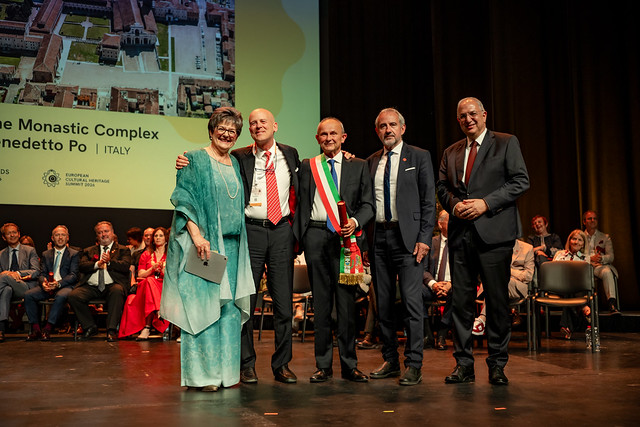
A particularly meaningful sign of this renewed confidence came in 2026, when the recovery and revitalisation of the site received both a European Heritage Award / Europa Nostra Award and a Grand Prix in the category Conservation and Adaptive Reuse. This European recognition acknowledged both the restoration work and long-term commitment of the community and institutions involved in bringing the monastery back to life.
Looking ahead, one of our main ambitions is to make this extraordinary site better known, both nationally and internationally. We want to attract new visitors and audiences and strengthen ties with a wider European cultural context, particularly through the Federation of Cluniac Sites.
What gives us hope is that the monastery is not simply a monument to be preserved, but a living heritage that continues to generate culture, knowledge and opportunities. The real challenge now is to share its history and meaning with an ever wider audience and with generations still to come.
The Europa Nostra team would like to extend our sincerest gratitude to Federica Guidetti for her participation in this interview, which was edited for length and clarity.
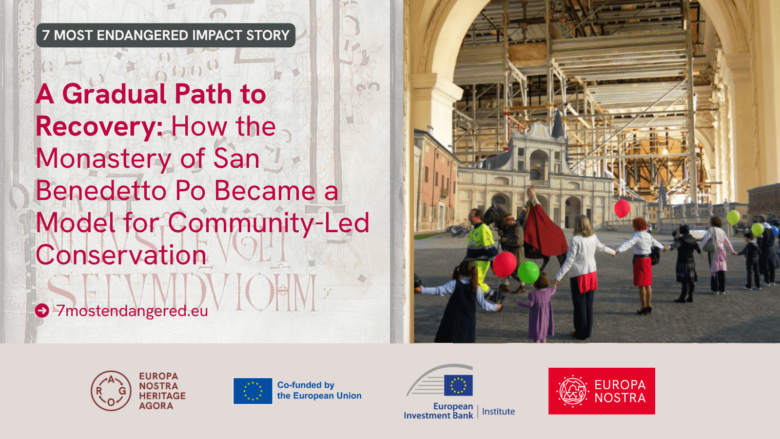
About the Impact Stories series
Since 2013, the 7 Most Endangered Programme – run by Europa Nostra with the support of the European Investment Bank Institute and the Creative Europe Programme of the European Union – has been committed to the protection of European heritage at risk. In this time, 77 threatened monuments and heritage sites from across 35 countries have been selected, each with its own unique history, community and story to tell. From ancient ruins to industrial landmarks, the sites reflect Europe’s diverse cultural landscape and the equally diverse challenges they face.
As part of our ongoing mission, we want to create a space dedicated to celebrating the people and organisations behind these sites, showing the long-term impacts of each small step taken in or beyond this Programme.
The 7 Most Endangered Impact Stories series is built around stories from selected sites across the Programme, drawing on interviews with the nominators and people directly involved in the Programme.
The first stories are being published in conjunction with the 2026 theme of European Heritage Days “Heritage at Risk: Revive, Resist, Reimagine” to join efforts in showcasing the many possible pathways towards safeguarding and giving new life to our heritage.