Europa Nostra and ALIPH panel discussion and exhibition showcase women at the forefront of protecting heritage and democratic values
On 3 March 2026 in Brussels, Europa Nostra and ALIPH – the International alliance for the protection of heritage, hosted a panel discussion, entitled “Women Safeguarding Cultural Heritage in Contexts of Conflict and Crisis”, and inaugurated the outdoor exhibition, “Portraits of Women – Beyond the Stones”, honouring eight women whose mission is to safeguard cultural heritage.
The panel, organised in the symbolic setting of the Zweig Visitor Centre of the European Parliament, sent a powerful message: protecting heritage is inseparable from protecting identity, memory and democratic values.

Photographer: Alain ROLLAND / © European Union 2026 – Source : EP
The event was held in the framework of the activities of the #Women4Heritage network coordinated by Europa Nostra under its network project Europa Nostra Heritage Agora, which is co-funded by the Creative Europe Programme of the European Union. Born during the European Year of Cultural Heritage, the network continues to grow, connecting women each year around International Women’s Day.
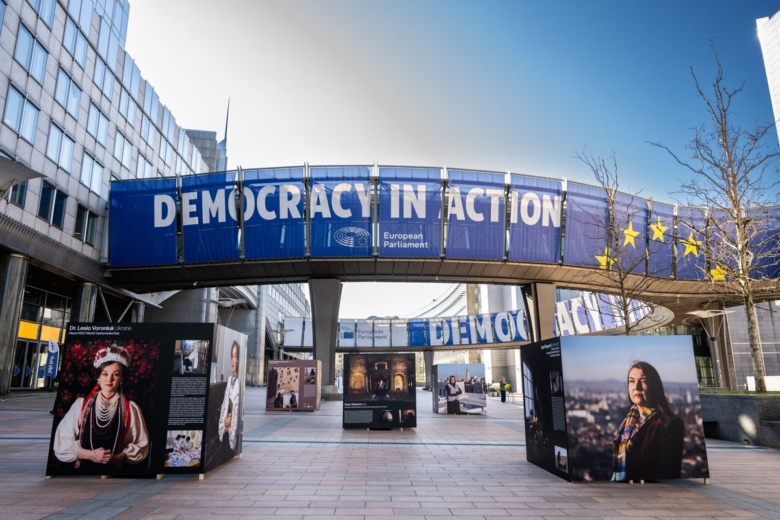
Photographer: Laurie DIEFFEMBACQ / © European Union 2026 – Source : EP
Reflections ahead of International Women’s Day
Sabine Verheyen, Vice-President of the European Parliament, joined the event to express her support for cultural heritage, and for the “women power” displayed in the outdoor photo exhibition. “If we lose our culture, if we lose our identity, what do we fight for? What do we protect? I think that is something we should always not forget — that culture is essential,” she said.
“That is why we have to fight now for a strong AGORA Programme, with a clear earmark for the culture part of the programme,” she added.
Opening the discussion, Philipp Schulmeister, Director, Directorate for Outreach, DG COMM of the European Parliament, presented the International Women’s Day 2026 campaign “Women’s Rights and Democracy: Combating Stereotypes, Disinformation and Violence in the Digital Age.”

Photographer: Alain ROLLAND / © European Union 2026 – Source : EP
He highlighted that 38% of Europeans still believe that a woman’s primary role is to care for the household, and that persistent stereotypes continue to undermine women’s participation in political life. Culture, he underlined, remains one of the most powerful tools to connect citizens with democratic processes, and has the power to speak when policy cannot. “The European Parliament stands firmly committed to gender equality, to cultural heritage and to ensuring that the voices and contributions of women are recognised,” he concluded.
Stories of women safeguarding heritage
The panel debate brought together three of the women featured in the exhibition “Portraits of Women — Beyond the Stones” in conversation with Sneška Quaedvlieg-Mihailović, Secretary General of Europa Nostra, and moderated by Sandra Bialystok, Director of Communications and Partnerships at ALIPH.

Photographer: Alain ROLLAND / © European Union 2026 – Source : EP
Introducing the discussion, Sneška Quaedvlieg-Mihailović emphasised the symbolism of hosting the exhibition in the European Parliament. “We are all actors of democracy,” she said. “In a world that seems to be breaking apart, women are stitching societies back together.”
She spoke of the essential role women play in reconnecting communities, fostering solidarity and celebrating diversity. The growing number of women-led heritage organisations across Europe and neighbouring regions reflects this transformative power.
Four of the women included in “Portraits of Women — Beyond the Stones” are laureates of the European Heritage Awards / Europa Nostra Awards, while four are partners of the ALIPH Foundation.
Lesia Voroniuk, Head of the NGO World Vyshyvanka Day in Ukraine, laureate of a European Heritage Award / Europa Nostra Award 2022, described the urgency of protecting cultural identity amid war. Her organisation has implemented over 70 projects worldwide, from exhibitions to educational campaigns.

Photographer: Alain ROLLAND / © European Union 2026 – Source : EP
Supported by ALIPH, twelve traditional outfits from occupied territories have been preserved and exhibited in museums across Ukraine and in Geneva. Despite massive attacks on energy systems and the daily hardship faced by communities, Ukrainian women continue to adapt and persevere. “This is not only a physical war, but also a cultural and hybrid war,” she said. Protecting heritage — through documentation, coordination and the recovery of stolen artefacts — requires sustained international cooperation.
From Georgia and Belgium, Mariné Mizandari, Chair of the National Trust of Georgia, reflected on her heritage work under increasing political pressure in Georgia. She warned that shrinking civic space and restrictions on freedom of expression threaten both democracy and heritage. International partnerships, mobility schemes and capacity building are now crucial to sustain civil society. “Democracy matters for heritage,” she affirmed.

Photographer: Alain ROLLAND / © European Union 2026 – Source : EP
Through the project with the International National Trusts Organisation (INTO), a historic tower in Akhieli, Georgia — symbol of local identity — was restored using an integrated, community-based approach linking cultural and natural heritage. The remarkable rehabilitation of the Tsiskarauli Tower received a European Heritage Award / Europa Nostra Award and the Grand Prix in the category Citizens’ Engagement & Awareness-Raising in 2024.
From Italy, Susy Galeone, founder of the La Paranza Cooperative, recounted the remarkable regeneration of the Rione Sanità neighbourhood in Naples. The social cooperative, recipient of a European Heritage Award / Europa Nostra Award 2022, transformed the Catacombs of San Gennaro and the Catacombs of San Gaudioso into vibrant cultural destinations, creating stable employment for 70 young people and recovering 13,000 m² of heritage.

Photographer: Alain ROLLAND / © European Union 2026 – Source : EP
The “Sanità method” was not designed as a strategy but emerged from necessity. Listening to the community, investing in education and giving young people recognised roles proved essential. “Caring for heritage is caring for people,” she said. Heritage, she reminded the audience, is not only what we inherit, but what we leave to the next generation.
Heritage as a superpower for Europe
In her concluding reflections, Sneška Quaedvlieg-Mihailović called on Members of the European Parliament to explore the stories behind the exhibition. “Heritage is not a technical or backward-looking matter. It is alive, and a powerful tool for dialogue, cohesion and peace,” she stated.
“Investing in culture, education and heritage is an investment in Europe’s security and defence in the broadest sense, as a vector to strengthen the EU’s enlargement and global agendas. A stronger cultural dimension across EU budgets is urgently needed”, she emphasised.
A global commitment
Closing the event, Sandra Bialystok recalled that ALIPH was founded nearly ten years ago in response to the targeted destruction of heritage in the Middle East and the Sahel. Designed as an agile and neutral partner complementing UNESCO, ALIPH has become a “heritage first responder.” As conflicts multiply worldwide, the urgency that led to ALIPH’s creation has only intensified.

Photographer: Alain ROLLAND / © European Union 2026 – Source : EP
Yet the stories shared in Brussels demonstrated that women — across generations and continents — remain at the forefront of protecting heritage and sustaining democratic values.
In May, the “Portraits of Women — Beyond the Stones” exhibition will travel to Cyprus during the upcoming European Cultural Heritage Summit 2026 in Nicosia, carrying its message of solidarity, sorority and peace closer to the Middle East.

Photographer: Laurie DIEFFEMBACQ / © European Union 2026 – Source : EP
Together, as the exhibition so eloquently conveyed, they form a powerful force for democracy, peace and dialogue — in Europe and beyond.
More photos
Panel discussion “Women Safeguarding Cultural Heritage in Contexts of Conflict and Crisis”
Photo exhibition “Portraits of Women – Beyond the Stones”