Europa Nostra expresses solidarity with United States’ cultural heritage actors who defend our shared values
Europa Nostra Statement (PDF)
Issued on the eve of 4 July 2026, which marks the 250th Anniversary of the Independence of the United States of America
In advance of the day marking 250 years since the United States declared its independence, Europa Nostra expresses its deep solidarity with the historic preservation advocates, civil society organisations, Indigenous Peoples, museum and archives professionals, and federal preservation colleagues in the United States who are working tirelessly to defend the integrity of cultural heritage practice at a moment of profound challenge.
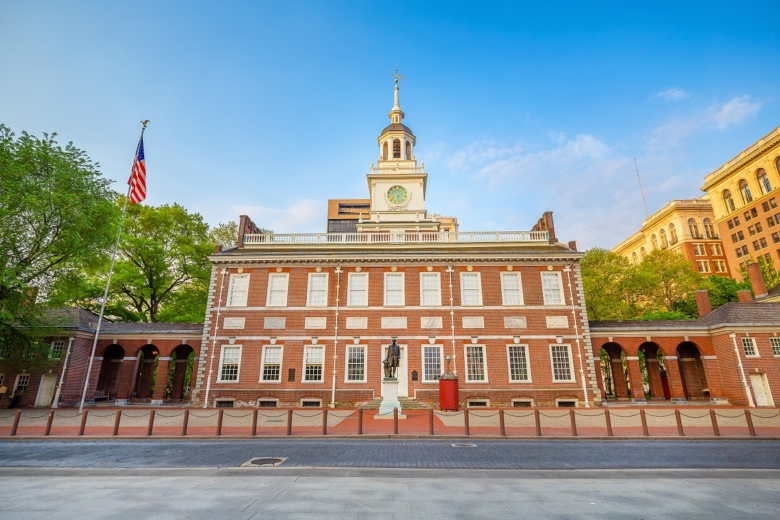
The Independence Hall in Philadelphia is a UNESCO World Heritage Site. The Declaration of Independence (1776) and the Constitution of the United States (1787) were both signed in this building. The universal principles of freedom and democracy set forth in these documents are of fundamental importance to American history and have also had a profound impact on law-makers around the world. Photo credit: Shutterstock
The United States was founded on ideals that resonate deeply with the values enshrined in the European project: democracy, the rule of law, and an evolving belief in the inalienable rights of all peoples. These shared principles – echoed in European instruments such as the Council of Europe Framework Convention on the Value of Cultural Heritage for Society (the Faro Convention) – have long formed the basis of transatlantic cooperation in the cultural field. Today, as the United States commemorates its 250th anniversary, these values require renewed vigilance and collective defense.
Under the administration of President Donald Trump, the United States has experienced a troubling erosion of long-standing norms that have traditionally guided its stewardship of cultural and natural heritage. Cultural heritage has increasingly been subjected to politicisation and instrumentalisation, including pressure on interpretive staff, the distortion or suppression of historical narratives, and the rollback of environmental and cultural protections. The sidelining of professional expertise, the suppression of climate science in heritage management, and the use of heritage as a tool of exclusionary nationalism represent a serious threat to democratic values and to the integrity of cultural stewardship.
At the same time, the United States’ withdrawal from key international cultural institutions, such as UNESCO, ICCROM and IUCN, weakens global cooperation at a moment when multilateralism is urgently needed to confront climate change, biodiversity loss, and threats to cultural rights. These withdrawals have created significant gaps in the international system, reducing opportunities for collaboration, and degrading time-tested platforms for exchange of knowledge, research and support between United States heritage professionals and their colleagues from the rest of the world.
In response, the European Union has signaled strong support for ICCROM, affirming that multilateralism remains essential and committing new resources to help stabilise the organisation during this period of American absence. As ICCROM itself noted, the EU’s action “comes at a critical moment” and reflects Europe’s determination to uphold international cultural cooperation when others step back. Europa Nostra welcomes this leadership and encourages similar reinforcement by the EU across all affected institutions during what we hope will be a brief period of U.S. absence.
The American heritage field enjoys the deep respect of its European colleagues. Europeans are profoundly concerned by these developments, which undermine principles that have long united Europe and the United States. We pay tribute to the many U.S. cultural heritage professionals, civil society organisations, Indigenous communities, museum workers, preservationists, archivists, and scholars who persevere, maintaining standards of excellence, and continuing to defend our shared values with courage, integrity, and professionalism. Their work is essential.
Europa Nostra’s Strategy 2026–2030, adopted by the General Assembly this past May in Nicosia, Cyprus, commits our organisation to strengthening multilateral cooperation, empowering civil society, and unleashing the power of heritage for democracy, social cohesion, and climate action. In this spirit, we offer not only solidarity but active partnership and support to our colleagues in the United States.
Defending Cultural Heritage as a Democratic Good
At the time when the United States heritage sector is facing politicisation – including the instrumentalisation of heritage for exclusionary nationalism – Europa Nostra’s Strategy places democracy, human rights, and cultural rights at the centre of heritage work.
We, the Europeans have long experience confronting the weaponisation of heritage for nationalist projects. We have rejected this misuse of heritage as a political tool and have worked to emphasise heritage as a force for inclusion, pluralism, and civic dignity. Therefore, we offer our hand and our experience as practical support to American colleagues seeking to defend these same principles.
Unleashing the Power of Heritage for Social Cohesion
At a time when American society has become deeply polarised, Europa Nostra’s Strategy emphasises heritage as a tool for bridging divides, strengthening communities, and building shared futures. It frames heritage not as a battleground with winners and losers but as a platform for reconciliation and belonging.
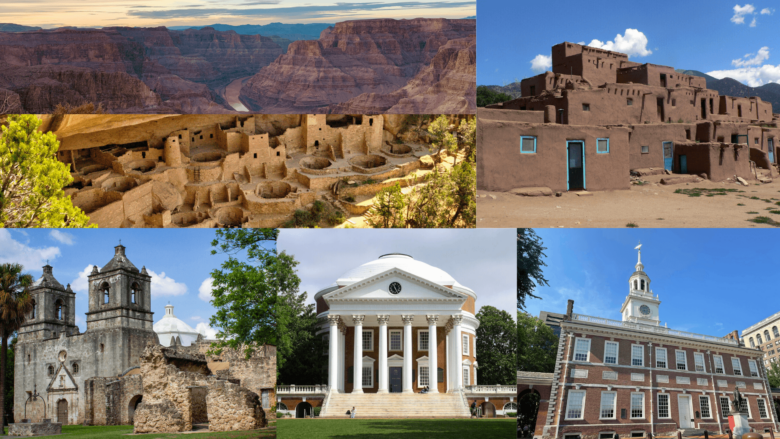
Photo collage of World Heritage Sites in the United States (from left to right): 1. Grand Canyon National Park, Arizona (Photo: Tim Hart / Unsplash); 2. Mesa Verde National Park, Colorado (Photo: Wallace Bentt / Unsplash); 3. Taos Pueblo, New Mexico (Photo: Edmondo Gnerre © OUR PLACE The World Heritage Collection); 4. San Antonio Missions, Texas (Photo: Joshua J. Cotten / Unsplash); 5. Monticello and the University of Virginia (Photo: Luis Castañeda © OUR PLACE The World Heritage Collection); 6. Independence Hall, Philadelphia, Pennsylvania (Photo: Ernie Journeys / Unsplash).
We hope U.S. colleagues can draw strength from this message. We stand ready to collaborate, share methodologies, and support heritage initiatives inspired by the official motto of the European Union: In Varietate Concordia (Latin for “United in Diversity”).
Making Climate Action Central to Heritage Practice
While the United States federal government has rolled back climate adaptation efforts and restricted climate communication at heritage sites, Europa Nostra’s Strategy affirms that climate action is a core responsibility of all those committed to heritage safeguarding. It calls for mobilising heritage for resilience, accelerating adaptation, and reducing the greenhouse gas emissions which are raising global temperatures.
This aligns directly with the work many U.S. heritage professionals want to do but are hindered from doing. Europa Nostra offers its expertise, networks, and tools to support American colleagues in advancing climate-heritage action despite institutional constraints.
Empowering Civil Society and Protecting Cultural Workers
Europa Nostra’s Strategy recognises the essential role of civil society, NGOs, and heritage professionals – and commits to protecting their independence and strengthening their capacity. In the U.S., where too many professionals have been fired and community voices silenced, our message is that our heritage colleagues from the United States deserve protection, respect, and freedom to uphold professional ethics. And we say: European colleagues will stand with you in defending that freedom.
These commitments reinforce what has long been the shared basis of European-American bonds, and we hope their reaffirmation offers a beacon of hope, solidarity, and practical support to our U.S. colleagues.
As the United States marks its 250th year, Europa Nostra recalls the profound thoughts expressed in Magnifica Humanitas, the recently published encyclical by Pope Leo XIV, an American with the name Robert Francis Provost who was born and raised in Chicago. In this spirit, we reaffirm that culture must be rooted in shared responsibility and solidarity – values that ensure culture serves people, not those in authority, and that heritage remains a force for dignity, inclusion, and peace.
On this historic anniversary of the independence of the United States, we stand with our colleagues and with all those in the United States who uphold these humanistic principles. We honour their commitment. We share their struggle. And we affirm that they are not alone.