Europa Nostra issues the Nicosia Manifesto “Heritage as the Soul of Mare Nostrum”
Read/share the full Mare Nostrum Manifesto (PDF)
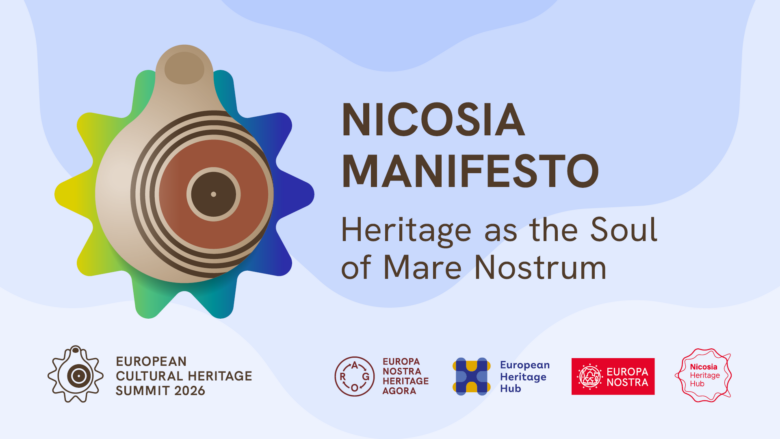
Image credits: Europa Nostra
We, professionals and volunteers, practitioners, researchers, educators, civil society activists who are committed to safeguarding and promoting cultural and natural heritage across the Euro-Mediterranean region and beyond;
Representing a diverse network of institutions, NGOs, local and regional authorities and communities from the Euro-Mediterranean region and beyond;
Gathered in Nicosia, Cyprus, from 26 to 30 May 2026 for the European Cultural Heritage Summit 2026 organised by Europa Nostra, the European Voice of Civil Society committed to Cultural Heritage, with the local support of Europa Nostra Heritage Hub in Nicosia, the support of the European Commission and under the patronage of the Cyprus Presidency of the Council of the European Union, with two key policy events organised on 29 May 2026, namely the European Heritage Policy Agora 2026 on “Mare Nostrum: Championing Environmental Sustainability through Cultural Heritage” and the European Heritage Hub Forum on ‘Mare Nostrum: Fostering Peace through Cultural Heritage”.
Recognising the symbolic and strategic significance of Cyprus as a millennia-old meeting point of cultures and religions; and paying tribute to the Greek Cypriot and Turkish Cypriot communities, local leaders, heritage experts, and civil society activists from our host city, Nicosia, the last divided capital city in Europe, who are dedicated to make good use of the cohesive and healing power of cultural heritage to build bridges between different communities and thus contribute to the much-needed reunification of their historic city;
Encouraged and inspired by the strong recognition of cultural heritage as a driver of sustainability, inclusion, solidarity and diplomacy in recent strategic documents adopted by the European Union, namely the Joint Declaration “Europe for Culture, Culture for Europe” signed by the Presidents of three key EU Institutions (the European Commission, the European Parliament and the Council of the European Union), giving a strong political endorsement to the Culture Compass for Europe presented by the European Commission on 12 November 2025;
Welcoming the strong emphasis on cultural heritage in the Pact for the Mediterranean adopted by the European Commission on 16 October 2025 under the motto “One Sea, One Pact, One Future”, which cover the European Union and ten countries from the Southern and Eastern Mediterranean[1];
Embracing the Mediterranean region as a rich and diverse mosaic of shared cultural and natural heritage (tangible, intangible and digital), and as a vast space of exchange, creativity, and coexistence;
Deeply concerned by the ongoing armed conflicts affecting people and heritage in a significant part of the Mediterranean, as well as by escalating pressures across the region caused by disasters due to natural hazards, coastal erosion, uncontrolled and unsustainable urban and touristic development as well as by numerous challenges caused by migration;
Strongly concerned by the fact that the Mediterranean region is a global climate‑change [2] hotspot;
Affirming that cultural heritage is not only a legacy of the past but also an invaluable resource for society today, as a vector for resilience, dialogue, peacebuilding, climate adaptation, and sustainable development as well as for social cohesion and inclusion;
Acknowledging, that, when manipulated, cultural heritage can fuel identity politics and conflict;
Highlighting the essential contribution of civil society networks and philanthropic foundations in advancing community-led action and cross-border collaboration in the field of heritage in the Euro-Mediterranean region and beyond;
We solemnly and urgently call upon decision-makers at all levels of governance, from local and regional to national and European, as well as relevant international organisations, philanthropic foundations, professional and civil society organisations, and other heritage stakeholders throughout the wider Euro-Mediterranean region to translate the ambition of the Joint Declaration “Europe for Culture, Culture for Europe”, the Culture Compass for Europe and the recently adopted Euro-Med initiative for culture, into a fully-fledged programme and mechanism dedicated to the protection and promotion of the shared Mediterranean cultural heritage.
This programme and dedicated mechanism should be developed and implemented around the following strategic goals:
1. Position cultural heritage as a key driver of sustainable development, social cohesion and participation by fostering its role for promoting intercultural dialogue and mutual respect and understanding between the people and countries of the Euro-Mediterranean region, and for building resilient and inclusive societies that support democratic participation and active citizenship for the benefit of the wellbeing and the quality of life of citizens and their communities.
2. Unleash the full potential of cultural heritage as a vector of peace, resilience and security by asserting its unique contribution to enhance dialogue and reconciliation, especially in contexts affected by conflict, division and instability, as well as by promoting cultural heritage cooperation as a complementary contribution to peacebuilding through shared stewardship, safeguard of heritage at risk, the empowerment of local actors, and the defence of cultural heritage against political manipulation.
3. Fully integrate heritage in initiatives to boost climate action and accelerate green transition by recognising that the fossil fuel economy drives a self-reinforcing cycle of war, proxy conflict and climate impacts across the wider Euro-Mediterranean region; by raising awareness that cultural and natural heritage is both vulnerable to these threats and represents a source of resilience, and by investing in cultural heritage as a tool for circular economy, climate adaptation, a just transition and equitable development within broader climate and sustainability frameworks, such as the UNFCCC process with the COP 31 taking place in November 2026 in the Eastern Mediterranean (Antalya in Türkiye) where the cultural heritage sector should have a strong and coordinated presence.
4. Ensure due protection of coastal and maritime heritage which form part of living ecosystems by treating ports, maritime landscapes, coastal settlements, fishing communities, and related traditional practices as interconnected ecological and cultural systems and by integrating maritime cultural heritage into environmental, coastal and ocean governance, while recognising the value of traditional knowledge in strengthening resilience and sustainable management.
5. Promote digital cultural heritage as a driver of inclusion, innovation and cooperation by promoting cross-border cooperation in digitisation, documentation and preservation, encouraging the ethical use of Artificial Intelligence and other emerging technologies, and strengthening shared digital infrastructures and open knowledge systems across the wider Euro-Mediterranean region.
6. Enhance common action against looting and illicit trafficking of heritage by developing adequate tools, strengthening cross-border cooperation, enhancing prevention and law enforcement measures, reinforcing international partnerships to protect heritage at risk, strengthening cooperation between customs, police and judicial authorities, and supporting coordinated international action against the destruction and illegal trade of cultural heritage.
7. Support capacity building and vocational training initiatives for a wide range of heritage related skills – from traditional craftsmanship to artificial intelligence –, also with a view to enhance sustainable economic development and inclusive growth, by investing in youth skills, knowledge transmission and site-based learning, while combining heritage conservation with employment opportunities, innovation and community-led regeneration.
The Nicosia Manifesto “Heritage as the Soul of Mare Nostrum” solemnly calls therefore for a decisive political and societal commitment to place cultural and natural heritage at the centre of the Euro-Mediterranean region’s present and future. Heritage must no longer be treated as a marginal, vulnerable and often contested remnant of the past, but recognised as a strategic and cohesive resource for resilience, peacebuilding, sustainable development, and regional cooperation.
At a time of accelerating climate pressures, geopolitical instability, and social fragmentation across Mare Nostrum, investing in heritage means investing in communities, dialogue, and cooperation aiming at long-term stability. Cultural and natural heritage (tangible, intangible, coastal, maritime, and living) has the power to connect societies across borders, strengthen democratic and civic participation, support climate adaptation, and foster inclusive prosperity.
Beyond preservation alone, heritage should be understood as an infrastructure of trust and shared intelligence: a living framework through which communities transmit knowledge, cultivate mutual understanding, and build the conditions for peace, resilience and sustained cooperation across diverse and divided societies.
Faced with the risk of escalation and the deterioration of the current geopolitical and environmental situations in the region, cultural heritage appears once again, as it has done throughout history, as an essential instrument to overcome conflicts and threats, and to play its crucial role in bringing people and civilisations together.
We therefore urge national, local and regional leaders across the wider Euro-Mediterranean region, governments, cities and civil society organisations, and all relevant international partners to act jointly with ambition and a sense of urgency: let us embed cultural and natural heritage across climate, development, peace, and neighbourhood policies; strengthen support for cross-border cooperation and local communities; recognise heritage as a cornerstone of a shared Mediterranean future; and harness its capacity to generate trust, shared intelligence and enduring partnerships across the Euro-Mediterranean region and beyond. By doing so, Mare Nostrum can once again become a thriving space of exchange, coexistence and collective resilience; benefiting present and future generations alike.
[1] Algeria, Egypt, Israel, Jordan, Lebanon, Libya, Morocco, Palestine, Syria and Tunisia
[2] Warming 20% faster than the global average and already experiencing about +1.5°C of temperature rise – well above many regions of the world. This region is facing sharper declines in rainfall (10–30%), more intense heat extremes and acute coastal vulnerability, with sea levels rising 2.8 mm per year and with projections of up to 1 metre by 2100 which could redraw the Mediterranean coastline, threatening historic cities such as Alexandria, Venice, Barcelona, Tunis, Izmir as well as the coastline of the islands. As a consequence, up to 20 million people could face permanent displacement.
Read/share the full Mare Nostrum Manifesto (PDF)
Join us in advocating for heritage