Europa Nostra publishes statement on advancements in the preservation of the Garden City La Butte Rouge, near Paris
Full Statement in English I French (PDF)
Europa Nostra, the leading European heritage civil society network, which launched its 7 Most Endangered Programme in 2013 with the support of the European Investment Bank Institute, is pleased to welcome the significant progress made in securing the long-term protection and sensitive rehabilitation of the Garden City La Butte Rouge in Châtenay-Malabry, near Paris.

The Garden City La Butte Rouge was listed among the 7 Most Endangered heritage sites in Europe for 2022. It is a living testimony of 20th-century social housing, and its architecture is strongly influenced by the Modern and Art Déco movements and the Bauhaus school. La Butte Rouge consists for the time being of some 3,300 apartments and a green area spreading around 60 hectares, and is home to thousands of people.
At the time of its listing, the Garden City La Butte Rouge was in urgent need of comprehensive renovation. Thanks to the campaigns led by civil society and the action of the Châtenay-Malabry municipality, the Garden City La Butte Rouge now benefits from new public instruments for architectural and landscape protection and planning.
On 5 July 2024, following a proposal by the municipality of Châtenay-Malabry, the Minister of Culture issued an “arrêté” (decree) classifying a little over half of its area and buildings as a “Site patrimonial remarquable” (SPR) (Remarkable Heritage Site), including its oldest parts and those with the greatest historical, cultural and landscape value (but several associations have filed a legal appeal requesting that the SPR be extended to the entire Garden City and beyond).
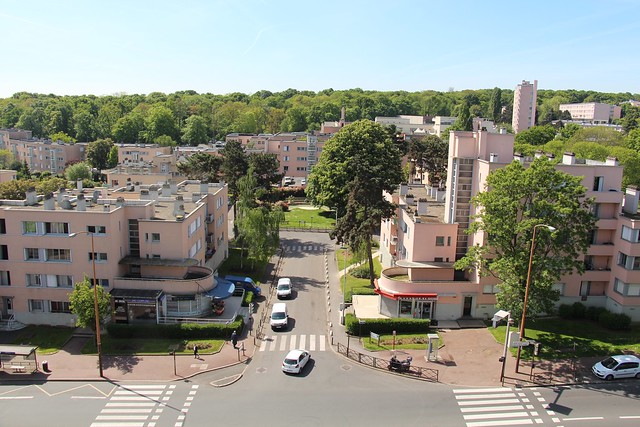
Under French law, an SPR is an instrument for protecting a city or a neighbourhood whose conservation, restoration, rehabilitation or enhancement is of public interest from an architectural, archaeological, artistic or landscape point of view. The SPR will be accompanied by a “Plan de valorisation de l’architecture et du patrimoine” (PVAP) (Architectural and Heritage Enhancement Plan) currently being drafted, which will contain an inventory of heritage and landscape features, rules relating to their conservation and enhancement, and requirements for buildings that will be preserved, rehabilitated with or without additions, restored or undergo more extensive renovation or reconstruction, with the latter two cases not exceeding 10% of the total.
For the Garden City as a whole, the municipality has established a “Plan local d’urbanisme intercommunal” (PLUi) (Local Intercommunal Urban Plan) accompanied by a document named “Orientations d’aménagement et de programmation” (OAP) (Development and Programming Guidelines) qualified as having an “heritage value”, a document that affirms both the protection of the site and the programming of activities, in ensuring the conservation of the gardens and the preservation of the quality of the landscapes and architecture, while regulating rehabilitations and reconstructions through strict and precise rules concerning the size of new buildings (footprint, volume, height, etc.) and the treatment of their architecture (materials, colours, openings, surroundings, etc.). (…)
It is clear that the concerns expressed in 2021, when several heritage associations feared “that 85% of the existing buildings (of the Garden City) will be torn down, the entire landscape wiped out,” are no longer relevant. Likewise, the Technical Report of 9 March 2023 and its “Conclusions and Recommendations” no longer reflect the current situation and therefore cannot represent Europa Nostra’s position in 2025. Furthermore, the report of the recent public “environmental” inquiry on the Garden City’s urban renovation project and on the work foreseen on the first three buildings concerned, and its “Conclusions motivées” (Reasoned Conclusions), were published on 16 June last and are favourable to the project, while addressing various questions to the social housing lessor.

Does this mean that a radiant future for La Butte Rouge is already assured? While Europa Nostra remains realistic as always in taking note of the new situation and agrees with the general objectives and philosophy of the project, namely the improvement of housing through a rehabilitation that respect the heritage values of the buildings with limited reconstruction and of social diversity, as well as the preservation of the landscape and character of the Garden City, it is however naturally not in its role to comment on the details of each planned intervention or on the question of social housing needs in the municipality. While considering that the Garden City is no longer in danger, it will remain attentive to be assured that, in the years to come, the project’s implementation methods genuinely improve the quality of life of its inhabitants while rigorously preserving the character and identity of La Butte Rouge, its Garden City values and those of its architectural and landscape heritage.
To this end, Europa Nostra will remain in close contact with the municipality and its heritage architects, but also considers that it is now primarily up to local and national heritage associations to do the same with a vigilant and constructive attitude, as several associations are already doing – including, among others, the “Conseil d’architecture, d’urbanisme et de l’environnement des Hauts-de-Seine” (CAUE 92) (Hauts-de-Seine Council for Architecture, Urban Planning and the Environment) and the “Association régionale des cités-jardins d’Île-de-France” (Regional Association of Garden Cities of Île-de-France) – three among them being even already part of the local SPR Commission supporting the project.
Under these conditions, the new “Site patrimonial remarquable” (Remarkable Heritage Site), together with the “Plan local d’urbanisme intercommunal” (Local Intercommunal Urban Plan) and its “Orientations d’aménagement et de programmation” (Development and Programming Guidelines), provides a framework to ensure that a site once feared to be in danger can be transformed into a successful architectural, urban, and landscape development, contributing to the well-being of its inhabitants and the preservation of an exceptional French and European heritage.