European experts call for immediate Grade 1 protection and adaptive reuse of British Barracks at Fort Chambray, Malta
A European expert team has released a Report on the preservation of the British Barracks at Fort Chambray in Gozo, Malta. An exceptionally important element of Gozo’s architectural, social and European heritage, the Barracks were constructed at the turn of the 20th century as married quarters for British military families, and are now threatened with demolition to make way for a new five-storey spa hotel, which would incorporate only a reconstructed version of the historic arcaded façade.

The British Barracks at Fort Chambray were listed among the 7 Most Endangered heritage sites in Europe for 2026, in the framework of the 7 Most Endangered Programme run by Europa Nostra with the support of the European Investment Bank Institute. The site was nominated by Din l-Art Ħelwa – the National Trust for Malta.
The European experts recommend protecting the British Barracks through Grade 1 scheduling and pursuing their adaptive reuse, arguing that conservation and economic development can be mutually supportive and that the building can contribute to the future sustainable development of Fort Chambray and Gozo.
The Report is being published in September as the appeal against the permission to demolish the Barracks is due to be heard. It follows the Europa Nostra experts’ Statement on the European Architectural, Cultural and Historical Significance of the British Barracks at Fort Chambray issued on 15 July.
Summary of the Report
The Report traces the history of Fort Chambray from its origins under the Knights of St. John through the British period, with particular attention to the British Married Quarters. Built at the turn of the 20th century, the Barracks are an unusually early and substantially intact example of purpose-built military family accommodation. Their later use as a hospital, including as Gozo’s leprosy hospital from 1937, adds further layers to their social and medical history.

The Report examines the architectural and environmental qualities of the Barracks, highlighting their distinctive limestone arcades, largely intact internal layout, and orientation and design features that enabled natural ventilation and provided protection from the Mediterranean climate. The building represents a distinctive synthesis of British military planning and local Maltese architectural and construction traditions.
The experts conclude that these qualities warrant immediate Grade 1 statutory protection. They note that comparable military married quarters in Malta and elsewhere have been recognised and retained for adaptive reuse, while the heritage value of the British Barracks in Gozo remains insufficiently protected.

The Report also reviews the development and redevelopment plans for Fort Chambray since the 1980s, as well as the significant public investment required for the restoration of the fortifications. Against this background, it assesses the current proposal, approved in December 2024, which would involve demolishing the historic Barracks and reconstructing their arcaded façade as part of a new five-storey spa hotel. The experts stress that reconstructing the façade would not preserve the building’s heritage significance, which depends on its original fabric, structure, interior layout, orientation and relationship with the wider fort.

As an alternative, the Report explores adaptive reuse options, with particular emphasis on a polyvalent Centre for Innovation and Heritage combining research and education, start-up incubation, co-working, training, conferences and public interpretation. A temporary cultural role during the 2031 European Capital of Culture programme could additionally provide an initial high-profile use. An economic analysis included in the Report indicates that such a use could provide a positive economic return while retaining the Barracks as a functioning heritage asset.
On-site mission
The Report was produced following an on-site mission to Malta conducted from 18 to 23 May 2026 by Graham Bell, Board Member of Europa Nostra, and Chris Hurst, retired agent of the European Investment Bank, expert volunteers of the 7 Most Endangered Programme. The mission included a site visit to Fort Chambray, providing the experts with valuable insights into the current condition of the British Barracks and their setting.
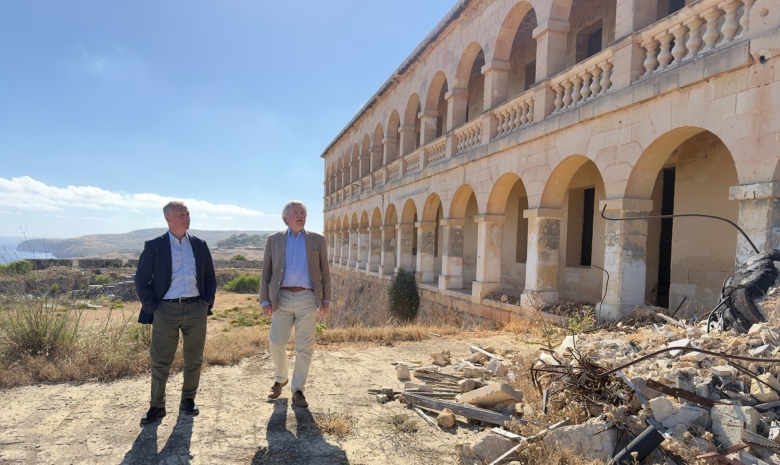
Chris Hurst and Graham Bell assessing the Barracks’ principal façade. Credit: Europa Nostra
With the support of Din l-Art Ħelwa – the National Trust for Malta, which nominated the British Barracks for the 7 Most Endangered Programme and played a key role in preparing and facilitating the visit, the mission team met with representatives of the Gozo Regional Development Authority, the Ministry for Gozo and Planning, the Planning Authority, the Office of the Superintendence of Cultural Heritage and the Chamber of Architects. Discussions were also held with conservation and built heritage experts, engineers and representatives of civil society and the University of Malta.
More information
Report on British Barracks at Fort Chambray (PDF)